
ACSF Levels Explained for RTOs
Understand ACSF levels, why they matter, and how RTOs can effectively apply them to assess learners, design training, and ensure learning success.
.avif)
If you run an RTO, ACSF levels matter. The 2025 ASQA Standards require you to assess your learners' LLND needs before training begins. The Australian Core Skills Framework is how you do that properly.
Think of the ACSF as a shared language for your whole team. It removes gut calls and guesswork. Instead, everyone uses one consistent tool to understand where learners are at. Trainers know how to pitch their delivery. Assessors know what they are actually testing for. Learners get the support they genuinely need.
This guide walks you through what ACSF levels are and why they matter. It also covers how to apply the framework across your RTO.
What Is the Australian Core Skills Framework?
The Australian Core Skills Framework (ACSF) is a national framework that describes performance across five core skills that adults use in their everyday lives and workplaces. It provides a common language for measuring and communicating skill levels. It is also the primary tool RTOs use when conducting Language, Literacy, Numeracy and Digital (LLND) assessments.
The five core skills covered by the ACSF are:
- Learning
- Reading
- Writing
- Oral Communication
- Numeracy
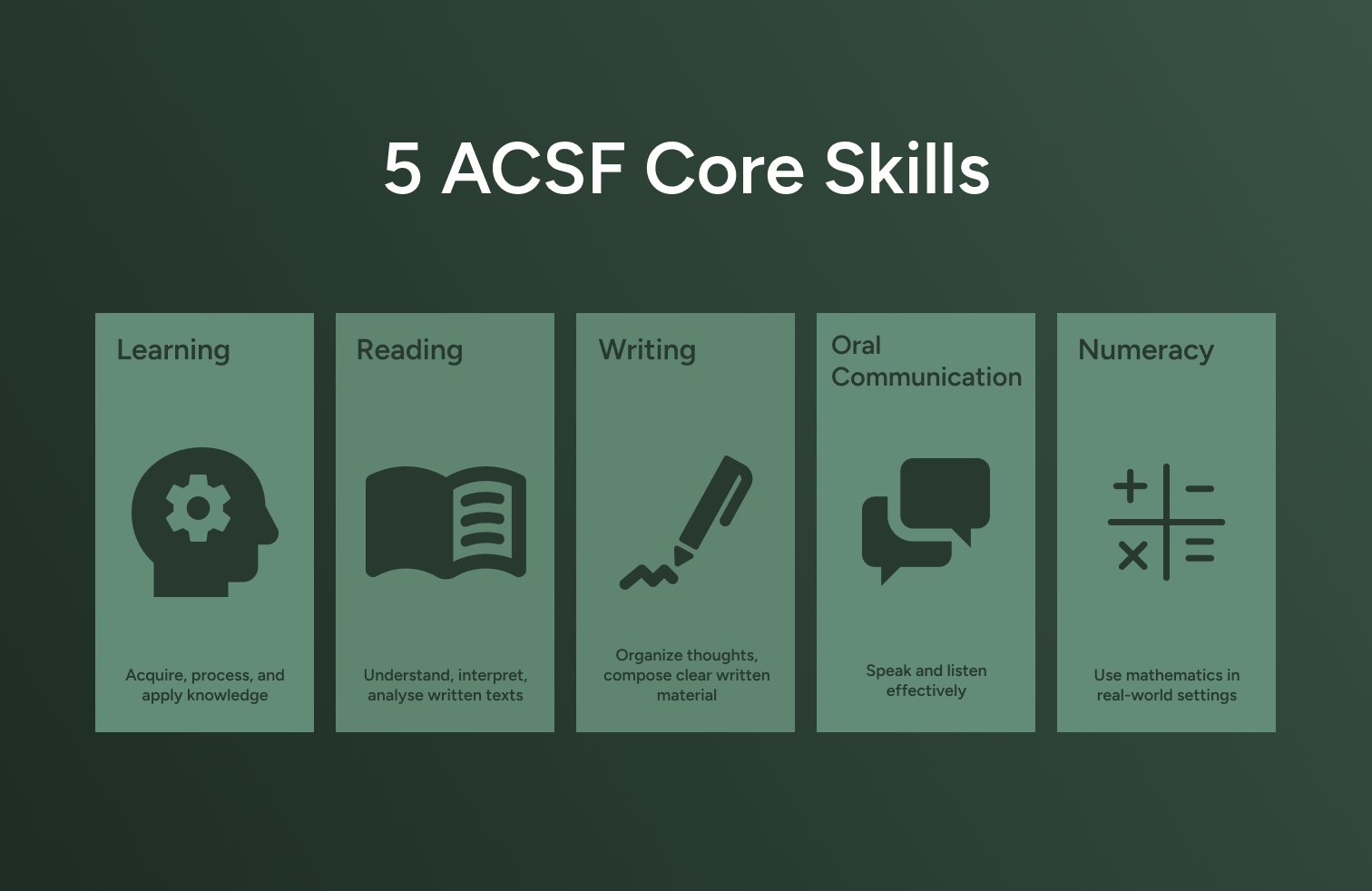
Each of these skills is described across five levels, from Level 1 at the most foundational end through to Level 5 at the most advanced. Knowing a learner’s level helps RTOs tailor training and provide extra support. It also ensures assessments match the learner’s ability.
ACSF Levels Explained
The ACSF uses a five-level scale to describe performance within each core skill. Here is what each level broadly represents:
- Level 1 describes very basic skill performance. A learner at this level can engage with short, simple texts and familiar tasks in highly supported environments. They typically rely heavily on visual cues, repetition, and one-on-one assistance.
- Level 2 describes emerging skills. Learners can handle simple, predictable tasks independently. They still need support with unfamiliar or complex content.
- Level 3 is the threshold for independent workplace and community functioning. Learners engage with various texts and tasks confidently. They can apply skills across contexts and handle some complexity without direct support.
- Level 4 shows strong, confident skills across many contexts. Learners interpret complex information, produce detailed writing, and solve multi-step numeracy problems.
- Level 5 represents highly developed, specialised skill performance. Learners handle complex, abstract, or technical material. They apply skills critically and independently in demanding situations.
For most vocational qualifications, core skill demands fall between Levels 2 and 4. Most units of competency sit within this range, though the specific level varies depending on the qualification and the unit. Mapping your training products to the ACSF shows exactly what you are expecting from learners. This helps you plan the right support before learners even enter the classroom.
Note: For more detail, see the Australian Core Skills Framework documentation.
Why ACSF Levels Matter for RTOs
The ACSF is not just a theoretical tool. It is the backbone of how your RTO identifies, responds to, and documents the LLN needs of your learners. Here is where it makes a real difference.
Pre-training review and enrolment
Before training begins, your RTO must understand if learners have the LLN skills to engage with the program. This is not about gatekeeping enrolment. It is about identifying needs early and putting the right support in place from day one. A learner assessed at Level 2 in Reading who is enrolling in a Certificate III with heavy written assessments will need targeted literacy support to succeed.
Training design and delivery
Knowing the ACSF level demands of a qualification helps you design delivery that actually works. It means choosing resources that match your learners' LLN levels, adjusting how content is explained, and building in opportunities for learners to develop their language, literacy, and numeracy skills alongside their vocational skills.
Assessment design
Every assessment task carries its own LLN demands. A written report pitched at Level 4 Reading and Writing may end up measuring a learner's literacy rather than their vocational competency. Mapping your assessments to the ACSF helps you check that your tasks are testing what they are supposed to test, not inadvertently penalising learners for their LLN level.
Reasonable adjustment
A learner's ACSF level is the starting point for any reasonable adjustment decision. Adjustments should be based on what the learner actually needs across their LLN skill areas, not made on guesswork. The ACSF gives you a structured, defensible basis for those decisions.
Supporting funding applications and reporting
Where government funding is available for core skills training, the ACSF provides a consistent basis for applications, progress reporting, and program evaluation. Using a shared national framework for these purposes supports accountability and makes it possible to generate meaningful data on the outcomes of funded programs across the country.
How to Apply the ACSF in Your RTO
Applying the ACSF does not require your trainers to become literacy specialists. It does require a structured approach that is embedded into your systems.
Map your training products
For each qualification or course, identify ACSF level demands across the five core skills. Use your training package and unit of competency materials to help. The ACSF support materials from the National Centre for Vocational Education Research (NCVER) provide detailed guidance.
Use a consistent pre-training review tool
Your enrolment process should gather information on a learner’s core skills. This could be a validated LLND assessment, a structured conversation guide, or both. The method matters less than applying it consistently.
Document what you find and what you do about it
Recording a learner’s ACSF level at enrolment is only useful if it reaches trainers. This information should guide the support you provide. Your student management system should make it easy to record, access, and act on these details.
Review regularly
A learner's core skill needs can change over the course of a program. Build in touchpoints to check in on progress and adjust support where needed.
Managing ACSF Requirements Without the Complexity
For many RTOs, the challenge isn’t understanding the ACSF. It is making enrolment data available to trainers, assessors, and support staff in a usable way.
RTOPilot brings learner data, support documents, and compliance records together in one place. Your team always has the context needed to deliver training that meets each learner’s needs.
Subscribe to receive the latest blog posts to your inbox every week.

Frequently Asked Questions
ACSF stands for Australian Core Skills Framework. It is a national framework used to describe and measure adult performance across five core skills: Learning, Reading, Writing, Oral Communication, and Numeracy.
There are five ACSF levels, ranging from Level 1 at the most foundational end to Level 5 at the most advanced. Most vocational qualifications sit within the Level 2 to Level 4 range.
All learners should complete a pre-training review that considers core skill needs. The depth of assessment may vary by qualification or learner background. The process should always be consistent and documented for every enrolment.
LLND stands for Language, Literacy, Numeracy and Digital skills. It is the broader term for the skill areas that RTOs are required to assess and support. The ACSF is the specific framework used to measure and describe those skills at different performance levels.
.avif)

Is your RTO future-ready?
See how RTOPilot can help.
Designed to help you spend less time and save money in running your RTO.
