
Explained for RTOs: AQF Certificate vs Statement of Attainment
Learn the difference between an AQF certificate and Statement of Attainment, what they must include, and how RTOs meet 2025 Standards requirements.

Subscribe to receive the latest blog posts to your inbox every week.

Issuing qualifications and statements of attainment is heavily regulated. These documents formally recognise a learner's achievements in Australia's national training system. Getting them wrong can lead to serious compliance consequences.
Yet for many RTO managers and compliance officers find the requirements confusing. What's the difference between a qualification certificate and a statement of attainment? What must each document include? When are you required to issue one? And what are the compliance obligations under the current standards?
This guide answers all those questions. It's based on requirements under the AQF and the Standards for RTOs 2025.
What Is an AQF Certificate?
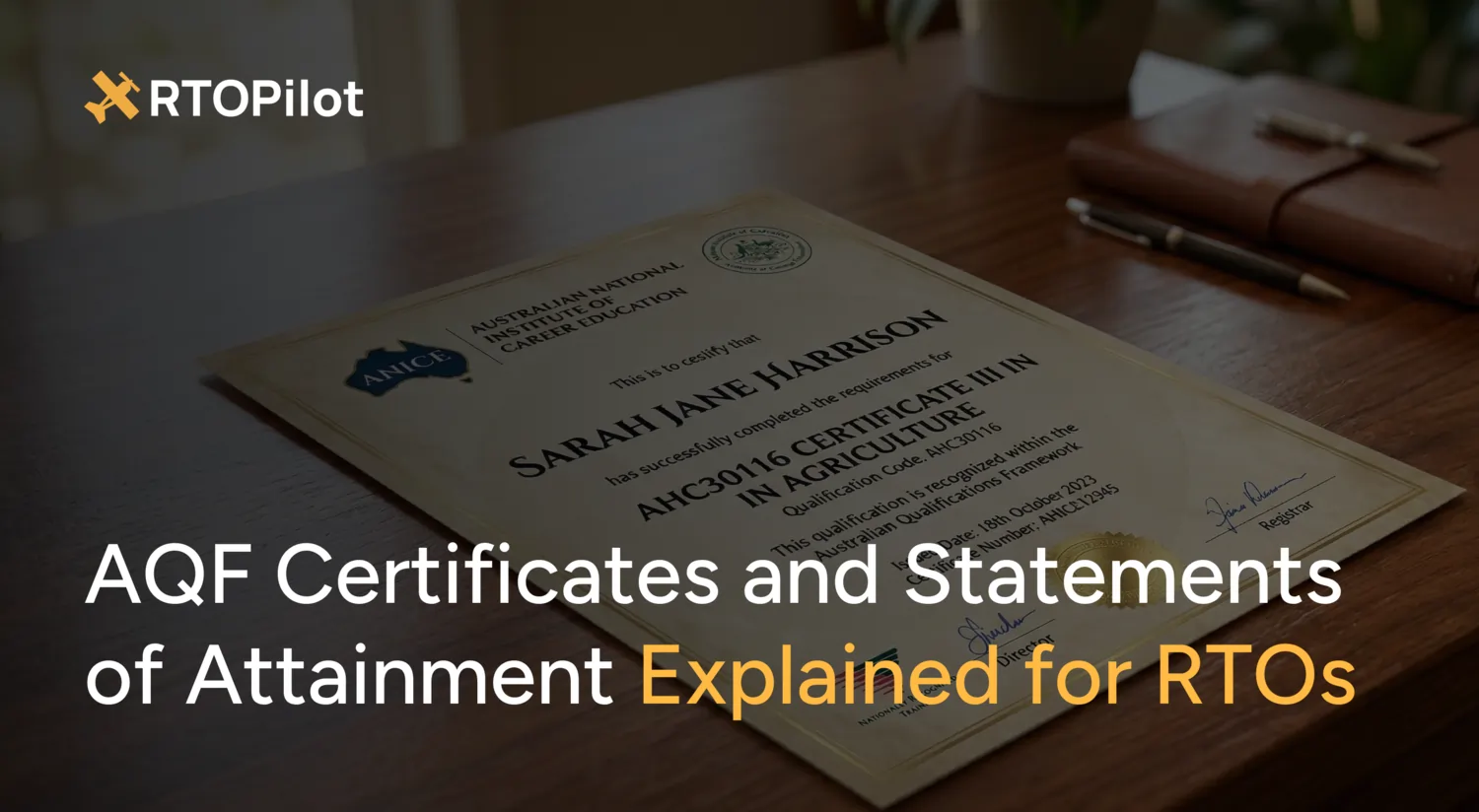
An AQF certificate, more accurately called a testamur, is the official qualification document. It's issued to learners who have completed all requirements of a full qualification. The AQF defines a testamur as formal certification that a qualification has been awarded.
A learner who completes all required units of competency is entitled to two documents. These are a testamur and a record of results. This applies to both training package qualifications and accredited courses. The record of results can be printed on the back of the testamur or issued as a separate document.
What Must an AQF Certificate Include?
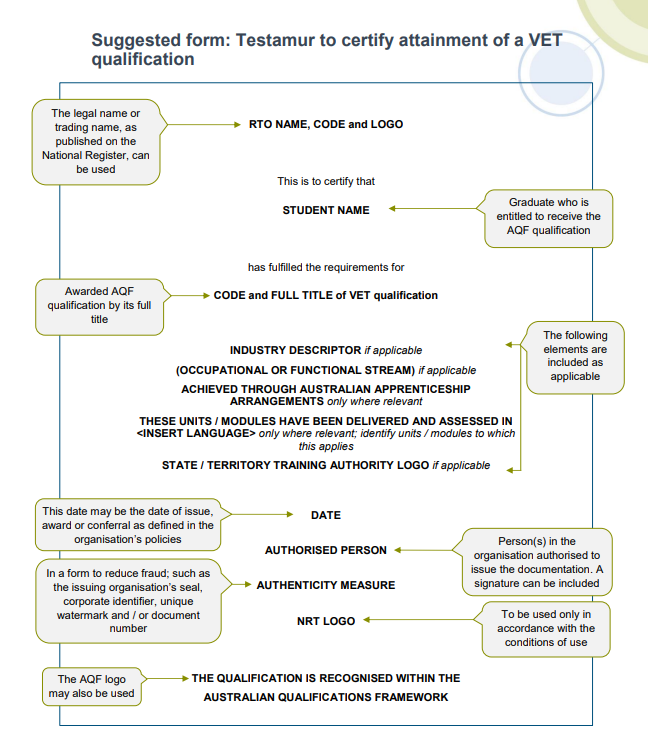
Every qualification issued by an NVR Registered Training Organisation must include the following:
- The name, registration code, and logo of the organisation
- The code and title of the AQF qualification
- The NRT logo — in accordance with the NRT Logo Conditions of Use policy
- The signature of an individual the organisation has authorised to sign the AQF qualification
- The organisation's seal, corporate identifier, or unique watermark
- The statement: "The qualification is recognised within the Australian Qualifications Framework" — or any AQF logo authorised by the Conditions for the Use of the Australian Qualifications Framework Logo policy
- Where the AQF qualification has an industry descriptor as listed on the National Register — the industry descriptor
- Where the AQF qualification has an occupational or functional stream listed on the National Register — the title of the stream in brackets after the code and title of the qualification
- Where the qualification has been obtained through an Australian Apprenticeship — the statement: "Achieved through Australian Apprenticeship arrangements"
- Where any part of the qualification has been delivered in another language — the statement: "These units of competency/modules have been delivered and assessed in [insert relevant language]" followed by a list of all relevant units or modules
What Is a Statement of Attainment?
A statement of attainment is issued when a learner completes one or more units of competency but not the full qualification. It is also issued upon completion of an accredited short course that doesn't lead to a full AQF qualification.
In plain terms, the difference comes down to how much a learner has completed. A learner who finishes every unit receives a testamur and record of results. A learner who exits before completing the full course receives a statement of attainment. This covers the units they successfully completed.
A statement of attainment should only be issued when a student exits a training program. This applies whether they completed the full program or not.
What Must a Statement of Attainment Include?
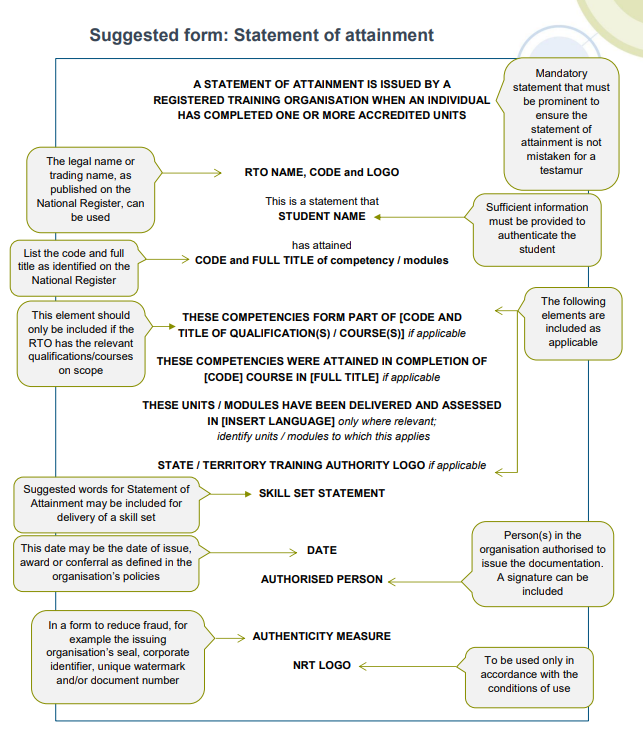
Every statement of attainment issued by an NVR registered RTO must include the following:
- The name, registration code, and logo of the organisation
- The full title and national code as set out on the National Register, of:
- each unit of competency to which the statement relates; or
- if no units of competency exist — each module to which the statement relates
- The NRT logo — in accordance with the NRT Logo Conditions of Use policy
- The signature of an individual the organisation has authorised to sign the statement
- The organisation's seal, corporate identifier, or unique watermark
- The statement: "A VET statement of attainment is issued by an NVR registered training organisation when an individual has completed one or more accredited units or modules"
- Where the units of competency form part of a VET course or qualification — the statement: "These competencies form part of [code and full title of the relevant VET course or qualification]"
- Where the units of competency were attained in completing a VET course — the statement: "These competencies were attained in completion of [VET course code] course in [full title of the VET course]"
- Where any units or modules have been delivered in another language — the statement: "These units of competency/modules have been delivered and assessed in [insert relevant language]" followed by a list of all relevant units or modules
Statement of Attainment vs Certificate: Key Differences
A statement of attainment is not a lesser document. It is formal, nationally recognised evidence of completed units. Learners can use it to apply for credit transfer when enrolling in a related qualification at another RTO. It also forms part of their Unique Student Identifier (USI) transcript.
When Must RTOs Issue Certification Documentation?
Timing is a compliance need, not a courtesy. RTOs must issue AQF certification documentation within 30 calendar days of assessment completion. This applies once the student has met all requirements.
Several conditions must be met before certification can be issued:
- USI verification is mandatory. Your RTO must verify a learner's USI before issuing any certification. Alternatively, you must have applied for a USI on the learner's behalf. Certification cannot be issued until one of these conditions is met.
- Fees must be paid. RTOs can only issue AQF certification documentation once all agreed fees for the training product have been paid.
- The USI must not appear on the certificate. A student's USI must not appear on any official certification or results statement.
- On student withdrawal. If a student withdraws after completing one or more units, the RTO must issue a statement of attainment. This covers the units they successfully completed. It is a requirement, not a discretionary decision.
Security, Authenticity, and Record-Keeping
Certification documentation must be secure, verifiable, and protected against fraud. Whether digital or printed, issue AQF certificates and statements of attainment automatically should include security features. These include unique identifiers, watermarks, and authorised signatures. Digital documents should also include encryption. RTOs can customise certification documents to suit their needs. All mandatory information must still be included.
There is one important restriction on what can appear on the document. Only the name of the issuing RTO can be included on testamurs and statements of attainment. Employer names and third-party arrangement partners cannot appear on the document.
RTOs must also maintain a register of all qualifications and statements of attainment issued. Records must be retained securely for audit purposes.
Superseded and Deleted Qualifications
Training packages are regularly updated. RTOs must understand their obligations when a qualification or unit changes.
RTOs must stop enrolling new students in a superseded training product. This must happen within one year of the replacement being listed on the National Register. For deleted qualifications, RTOs have two years from the deletion date. This time must be used to complete training and issue AQF certification.
For accredited short courses, the timeframe is shorter. All learners must complete the course within one year of removal from the National Register. Certification must also be issued within that period.
Monitor training package updates on training.gov.au. Build a review process into your compliance calendar to avoid missing transition deadlines.
How RTOPilot Supports Certification Compliance
Managing certification documents manually adds unnecessary compliance risk. Tracking completion dates, verifying USIs, and generating certificates all create room for error. So does maintaining issuing registers. RTOPilot’s Student Management System removes that risk. It automates certificate generation and tracks USI verification. It monitors completions against the 30-day requirement. It also keeps a secure, auditable record of all issued credentials.
Frequently Asked Questions
RTOs must issue AQF certification documentation within 30 calendar days of assessment completion. This applies to both testamurs and statements of attainment.
Yes. A statement of attainment is nationally recognised evidence of completed units. Learners can present it when enrolling in a related qualification at another RTO. The receiving RTO should consider it for credit transfer and verify authenticity via the USI transcript or by contacting the issuing RTO.
No, it is prohibited. A student’s Unique Student Identifier (USI) must not be included on any certificate or results statement. However, the USI must be collected and verified before issuing any certification documentation.



Is your RTO future-ready?
See how RTOPilot can help.
Designed to help you spend less time and save money in running your RTO.
