
VET Data Streamlining (VDS) Program: What RTOs Need to Know
Learn what the VET Data Streamlining (VDS) program is, its recent updates, and discover how your RTO can prepare for the upcoming VET data changes.


Subscribe to receive the latest blog posts to your inbox every week.

Data reporting has long been one of the most time-consuming parts of running an RTO. Between AVETMISS submissions, state funding reports, and USI verification, the workload adds up quickly. Training providers often enter the same information into multiple systems. Different schedules, different formats, and different portals make this even harder.
The VET Data Streamlining (VDS) program is an Australian Government initiative designed to change that. It modernises how VET data flows across the sector. The goal is to reduce duplication, improve data quality, and ease the compliance burden on training providers. Stage 1 is now underway. The new VET Information Standard is expected in early 2026. This is no longer a future concern for RTOs. It's a present one.
What Is the VET Data Streamlining Program?
The VDS Program is part of Australia’s broader Enhanced VET Data and Evidence initiative under the National Skills Agreement. Its goal is to modernise the national VET data landscape. It replaces outdated standards and reporting methods with a streamlined, secure, and integrated system.
Once fully implemented, VDS will deliver faster, richer data. This gives stakeholders better insight into skills gaps and shifting labour demands. It also supports a more targeted response to training quality challenges across the country.
Three Key Components of the Program
The VDS Program has three major components that work together to modernise VET data systems:
1. New VET Information Standard
At the heart of the program is a modernised VET Information Standard. It replaces the legacy AVETMISS 8.0 data format. The new standard defines what data is collected and how it's structured. It also ensures consistency across all jurisdictions and providers.
2. Student and Training Activity Reporting System (STARS)
The Student and Training Activity Reporting System (STARS) is a new digital platform built to support the new data standard. It integrates with existing Student Management Systems (SMS) used by training providers. Data can be submitted and validated in a modern, streamlined way. STARS aims to reduce delays, improve data accuracy, and drive more frequent reporting.
3. Policy and Legislation Updates
A modern national data system requires updates to existing policies and legislation. These changes ensure legal and regulatory frameworks support more frequent and secure data submission. They also align with the new information standard and reporting technologies.
More details, including timelines, are available on the DEWR website
When Will the New VET Data System Take Effect?
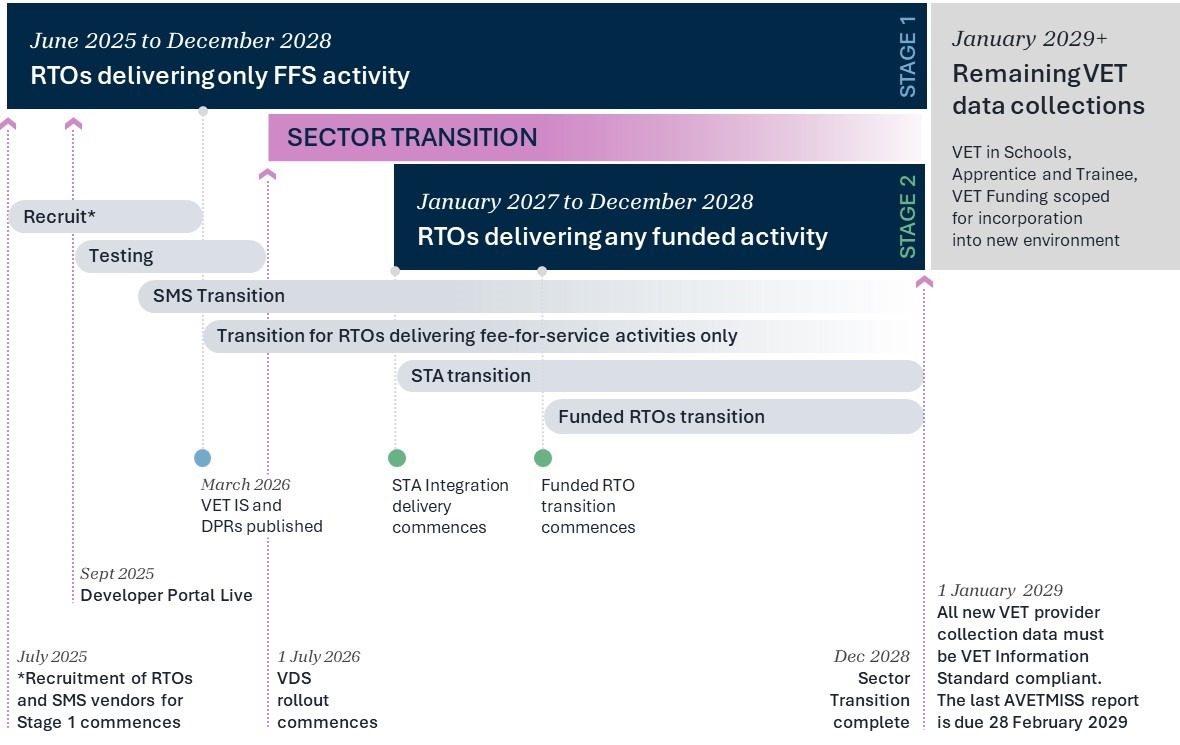
VDS is being rolled out gradually over several years. Under the extended National Skills Agreement, the program runs through 31 December 2028. This gives training providers, SMS vendors, and regulators time to transition smoothly. RTOs will adopt the VET Information Standard and connect to STARS in phases. This approach gives providers time to adjust their systems, reporting procedures, and internal processes.
What VDS Means for Your RTO Right Now
- Continue current AVETMISS reporting. Submission processes remain the same until your jurisdiction confirms formal transition timelines.
- Fee-for-service RTOs should pay attention. Stage 1 targets fee-for-service RTOs and SMS vendors. Check with your SMS provider to understand what participation means for your operations.
- Check in with your software provider. Ask: Are you registered on the VDS Developer Portal? What is your roadmap for VET Information Standard alignment and STARS integration? A provider without clear answers is a serious risk.
- Focus on data quality. VDS automates reporting but doesn’t fix incorrect data. RTOs with clean, AVETMISS-compliant data will transition more smoothly.
- Stay informed. With Stage 1 underway and the VET Information Standard publication approaching, program activity is accelerating. NCVER runs VDS Program Showcases every ten weeks - a practical way to stay up to date.
Steps to Prepare Your RTO for VDS
Even if VDS is not fully live in your state, you can take steps to get ready:
Step 1: Audit Your Current Data Collection Processes
Before you can benefit from streamlined reporting, your underlying data needs to be clean and complete. Review your enrolment forms, data entry workflows, and student management records. Look for common issues such as missing fields, inconsistent formats, and unverified USIs.
Step 2: Assess Your Current Software
Ask your SMS provider directly: Are you aligned with the VET Data Streamlining program? What is your roadmap for VDS integration? Which data flows are currently supported, and what's coming? A software provider that can't answer these questions clearly is a risk worth taking seriously.
Step 3: Move Toward a Single Integrated Platform
If your RTO manages student data across disconnected systems, now is the time to consolidate. Separate enrolment tools, spreadsheets, or an LMS that doesn't connect to your SMS all create risk. VDS is built on the principle of a single, accurate source of data. Your internal systems should follow the same approach.
Step 4: Train Your Team on Data Quality
VDS automates data reporting but it won't fix data that's incorrect at the source. Make sure staff responsible for data entry understand AVETMISS requirements. They need to know how to collect information correctly at enrolment. They should also understand why data quality matters beyond just submission.
Step 5: Stay Informed as the Program Evolves
VDS is an ongoing program with a multi-year implementation horizon. Sign up for updates from DEWR and follow NCVER and your state training authority for VDS-related communications. Make sure your software provider is keeping you informed about changes that affect your reporting obligations.
How RTOPilot Supports the VDS Transition
RTOPilot is purpose-built for Australian RTOs. Staying ahead of VET sector data requirements is central to the platform. Its TMS and SMS are built around the AVETMISS standard. They are also designed to support the evolving VDS framework. This gives your RTO a compliant, connected foundation for current and future reporting obligations.
Frequently Asked Questions
VDS is being implemented progressively across states and territories. The pace of rollout varies by jurisdiction. For current obligations, contact your state training authority or DEWR directly.
Yes, eventually. The new VET Information Standard will replace AVETMISS 8.0 as the national data standard. However, this transition is still underway. AVETMISS remains fully in effect. RTOs must continue meeting all current AVETMISS obligations. Full sector transition is targeted for 31 December 2028.
Not necessarily, but it's worth reviewing your processes. VDS relies on accurate, AVETMISS-compliant data collected at enrolment. If there are gaps in how your team captures student information, now is the right time to address them.



Is your RTO future-ready?
See how RTOPilot can help.
Designed to help you spend less time and save money in running your RTO.
