
Recognition of Prior Learning (RPL) Guide for RTOs
Learn what Recognition of Prior Learning (RPL) is and how RTOs can effectively assess learners’ prior skills, knowledge, and experience compliantly.
.avif)
Recognition of prior learning is one of the most valuable services an RTO can offer. When implemented effectively, RPL recognises learners’ existing knowledge, skills, and experience. It provides faster and fairer pathways to nationally recognised qualifications. This process avoids unnecessary repetition of training learners have already mastered.
This guide explains what recognition of prior learning means in practice. It outlines the RPL requirements RTOs must meet under the 2025 ASQA Standards. It also shows how to build a process that delivers strong outcomes for both students and your organisation.
What Is Recognition of Prior Learning?
Recognition of prior learning is a formal assessment process used by training organisations. It evaluates a learner’s existing skills, knowledge, and relevant experience. These are assessed against the requirements of a unit of competency or qualification. Instead of completing training from the beginning, learners may demonstrate they already meet the required standards. Evidence can include work experience, previous formal study, or relevant informal learning. Often, learners provide a combination of these sources to support their assessment.
In practical terms, what is recognition of prior learning? It is a pathway, not a shortcut. A successful RPL outcome carries the same weight as any other assessment result. The learner is deemed competent because the evidence proves they are competent, not because they sat through a course.
RPL is available across all AQF-aligned qualifications and must be offered by RTOs as a legitimate assessment option. It cannot be treated as optional or discouraged in favour of full enrolment.
Why RPL Matters for RTOs
Many adult learners entering or returning to the workforce carry years of relevant experience. A plumber with 15 years of site experience already demonstrates strong practical skills. A childcare worker trained overseas may also possess recognised knowledge and experience. A manager who has led teams for a decade already understands core leadership practices.
When your RTO does RPL well, it shows. Learners notice when their experience is taken seriously rather than ignored. It also makes your RTO a more attractive option for experienced workers who are weighing up their choices and have no interest in sitting through training they have already outgrown.
That said, RPL is only as credible as the process behind it. Poorly collected evidence and inconsistent assessor decisions weaken its reliability. Missing documentation is another common issue flagged during audits.
RPL Requirements Under the ASQA Standards
Under the 2025 RTO Standards, Standard 1.6 defines obligations for RPL. It is part of Division 3, covering RPL and Credit Transfer requirements. This standard operates as an Outcome Standard with three clear performance indicators.
1. Students must be offered RPL opportunities and informed of your policies.
Every VET student must be given the opportunity to seek recognition of prior learning. This is not just about having RPL available. RTOs must actively inform students that RPL is available to them. They should clearly communicate policies for accessing it at enrolment. This requirement should appear in pre-training information, the student handbook, and enrolment documents.
2. RPL decisions must be evidence-based and consistent with your assessment system.
RPL decisions cannot rely on goodwill, reputation, or verbal claims. They must be based on evidence of prior skills, learning, and experience. Assessments must follow your RTO’s established system and processes.
This ensures the RPL process is part of the broader assessment framework. It should not operate separately from other assessment procedures.
3. Decisions must be documented, fair, transparent, and consistent.
The standard is clear: RPL outcomes must be documented fairly, transparently, and consistently. Decisions must also protect the integrity of the training product. Any RPL that undermines qualification quality is non-compliant, regardless of paperwork.
This covers inconsistent assessor decisions, missing documentation, or students being uninformed. Auditors require evidence that all three performance indicators are consistently met.
Building a Compliant RPL Process
A reliable RPL process does not need to be complicated, but it does need to be consistent. Here is a practical structure to work from.
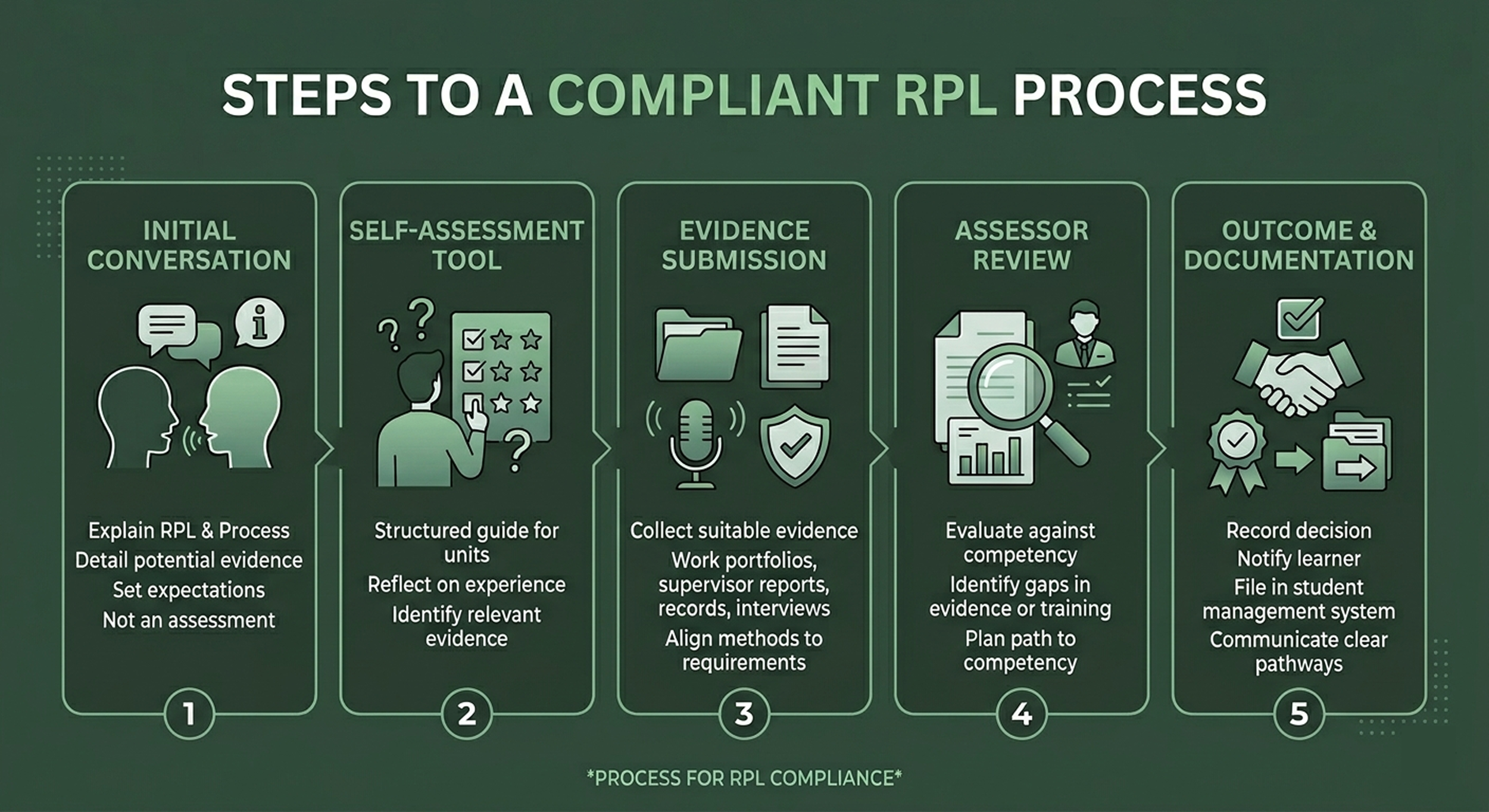
Step 1: Initial conversation
When a learner makes contact, your team should explain what RPL is, what the process involves, and what evidence they may need. This is not an assessment conversation. It is an information and expectation-setting conversation.
Step 2: Self-assessment tool
Give learners a structured self-assessment guide for units they seek credit in. This helps them reflect on their experience and start identifying relevant evidence before formal assessment begins.
Step 3: Evidence submission
Collaborate with the learner to collect suitable evidence for RPL assessment. This may include work portfolios, third-party supervisor reports, qualification records, position descriptions, or structured interviews. The evidence-gathering method should align with the unit requirements.
Step 4: Assessor review
A qualified assessor evaluates the evidence against the unit of competency. If gaps are found, they identify additional evidence or gap training needed before granting competence.
Step 5: Outcome and documentation
The decision is recorded, the learner is notified, and all documentation is filed in the student management system. If the outcome is not yet competent, a clear pathway forward should be communicated.
Common RPL Pitfalls to Avoid
- Treating RPL as a tick-box exercise. Approving RPL applications without sufficient evidence review is a compliance risk and an integrity issue. Each decision needs to be defensible.
- Relying on a single evidence type. A resume alone is rarely sufficient. Strong RPL assessments draw on multiple sources that together build a complete picture of competence.
- Inconsistent assessor decisions. If two assessors reviewing similar experience reach opposite conclusions on the same unit, your process has a reliability problem. Moderation and calibration sessions help keep decisions consistent.
- Poor record-keeping. If an ASQA auditor asks to see the evidence behind an RPL outcome, you need to be able to produce it. Scattered files, missing documents, and incomplete records create unnecessary risk.
Managing RPL Without the Admin Headache
For many RTOs, the challenge with RPL is not understanding the requirements. It is managing the paperwork and workflow without things falling through the cracks. Evidence collection, assessor sign-offs, outcome recording, and audit trails all need to happen in a structured, traceable way.
RTOPilot supports the compliance workflows Australian RTOs need, including RPL. With assessor task management, student records, and audit-ready documentation combined, teams can manage RPL consistently. This eliminates the need for spreadsheets or scattered email communications.
Subscribe to receive the latest blog posts to your inbox every week.

Frequently Asked Questions
Recognition of prior learning (RPL) formally assesses a learner’s existing skills, knowledge, and experience. If evidence shows they meet the standard, they are deemed competent without completing the full training program.
No. Under Standard 1.6 of the 2025 ASQA Standards, RTOs must offer VET students the chance to seek RPL. Discouraging RPL or failing to inform students about it breaches this standard.
No. Credit transfer applies when a learner has completed the same or equivalent unit with another RTO. RPL, on the other hand, assesses informal and non-formal learning, including work experience, on-the-job skills, and life experience not previously recognised.
RPL timeframes depend on the qualification, evidence volume, and learner responsiveness. A single-unit application may take a few days, while a full qualification could take several weeks. RTOs should set clear expectations with learners from the start.
Evidence must be sufficient, relevant, current, and authentic. Common evidence types include:
- Work samples and portfolios,
- Position descriptions,
- Third-party reports from supervisors or employers,
- Photos or videos of work being performed, and
- Records of previous training or professional development.
A single piece of evidence is rarely enough. A strong RPL application draws on multiple sources.
If a learner lacks enough evidence for competence, the assessor should identify gaps. They must explain what additional evidence or gap training is needed. A not yet competent outcome is not a final decision. It is a starting point for a clear pathway forward.
Is your RTO future-ready?
See how RTOPilot can help.
Designed to help you spend less time and save money in running your RTO.
