
How RTOs Can Use Data and Feedback to Drive Continuous Improvement
Understand Standard 4.4 requirements, key data and feedback sources, and practical ways to strengthen compliance and prepare for ASQA audits effectively.

Subscribe to receive the latest blog posts to your inbox every week.

Continuous improvement is one of the most talked-about obligations in the VET sector, and one of the most misunderstood. Many RTOs treat it as a survey they send at the end of a course, or a folder of complaint forms nobody revisits. Under the 2025 Standards for RTOs, that approach won't hold up at audit.
This article breaks down what continuous improvement actually requires under Standard 4.4, where the data should come from, and how to build a system that turns feedback into evidence auditors can see.
What Continuous Improvement Means Under the 2025 Standards for RTOs
Continuous improvement sits under Standard 4.4, part of the Outcome Standards, Part 4 (Governance), Division 3. The Standard requires an RTO to undertake systematic monitoring and evaluation of its own performance, to support quality delivery and ongoing improvement.
The Performance Indicators break this down into three parts. Your RTO must demonstrate:
- A system for monitoring and evaluating performance against the Standards and compliance requirements.
- How the outcomes of that monitoring inform continuous improvement, with clear evidence that the data led to real changes in delivery or assessment.
- Lawful mechanisms to collect and analyse data and feedback from students, staff, industry, VET regulators, state and territory training authorities, and employers of current or former students.
The distinction that trips up most RTOs is the second point. Auditors aren't looking for a stack of survey results. They're looking for a clear line between what the data showed and what the RTO did about it.
Why Your RTO Needs a Continuous Improvement Policy
A continuous improvement policy sets out how your RTO meets Standard 4.4 in practice. Without one, improvement activity tends to happen inconsistently, driven by whoever notices a problem first rather than a defined process.
A working policy should cover:
- Data sources: The feedback channels and records that feed into the system, and how often each one is reviewed.
- Roles and ownership: Who reviews the data, who decides on actions, and who signs off when an action is complete.
- Review cycle: How frequently each data source is analysed. Some sources need continuous review, others suit a periodic cycle.
- Reporting lines: How findings and outcomes reach the governing body, and how stakeholders learn what changed as a result of their feedback.
How to Use the Data and Feedback for Continuous Improvement
Standard 4.4 expects RTOs to draw on feedback from a broad range of stakeholders, including students, trainers, employers, industry, and regulators. Each source carries different information and needs a different kind of action.
1. Student Feedback
- End-of-course surveys
- Day-to-day questionnaires
- Exit interviews
How to use it: Your compliance team should track scores and comments by unit and trainer across each intake. If the same unit or trainer shows low scores for three intakes in a row, the team should log it in the continuous improvement register and schedule a review of the training materials or delivery approach.
2. Trainer and Assessor Input
- Delivery observations
- Resource reviews
- Moderation session notes
How to use it: Training managers should collect this input at the end of each teaching block. They should use it to update training materials or assessment tools before the same gap shows up in student feedback, and to identify trainers who need extra support or coaching.
3. Employer and Industry Feedback
- Work placement reports
- Traineeship check-ins
- Graduate outcome surveys
How to use it: Your training and assessment strategy owner should compare employer feedback against the current strategy each year. Where employers flag skills gaps, they should update the relevant units or assessment tasks and record the change with a date and reason.
4. Complaints and Appeals
- Formal complaints
- Appeals against assessment decisions
- Informal issues raised directly with staff
How to use it: The compliance officer should log every complaint into the continuous improvement register as it happens, not in batches, and review the register monthly for repeat complaints about the same unit, trainer, or process. Any repeat should trigger an investigation into the root cause.
5. Validation and Moderation Outcomes
- Validation session findings
- Moderation reports
- Assessment judgement comparisons across trainers
How to use it: The validation lead should check outcomes after each session for inconsistent judgements between trainers or cohorts. Where inconsistency shows up, they should rewrite the affected assessment tool or instructions and re-validate at the next cycle.
6. Internal and External Audits
- Internal audit reports
- ASQA audit findings
- Recommendations from external review
How to use it: The compliance officer should turn every audit finding into a dated action with a named owner, then track each action through to close-out and keep the evidence, since this is the first thing an auditor checks at the next audit.
Together, these sources build a fuller picture than any single one on its own. Complaints surface acute problems quickly. Validation outcomes reveal slower-moving issues with assessment quality. Relying on one source at the expense of the others leaves gaps an auditor is likely to find.
Also read: How Automation is Transforming Compliance for RTOs in Australia
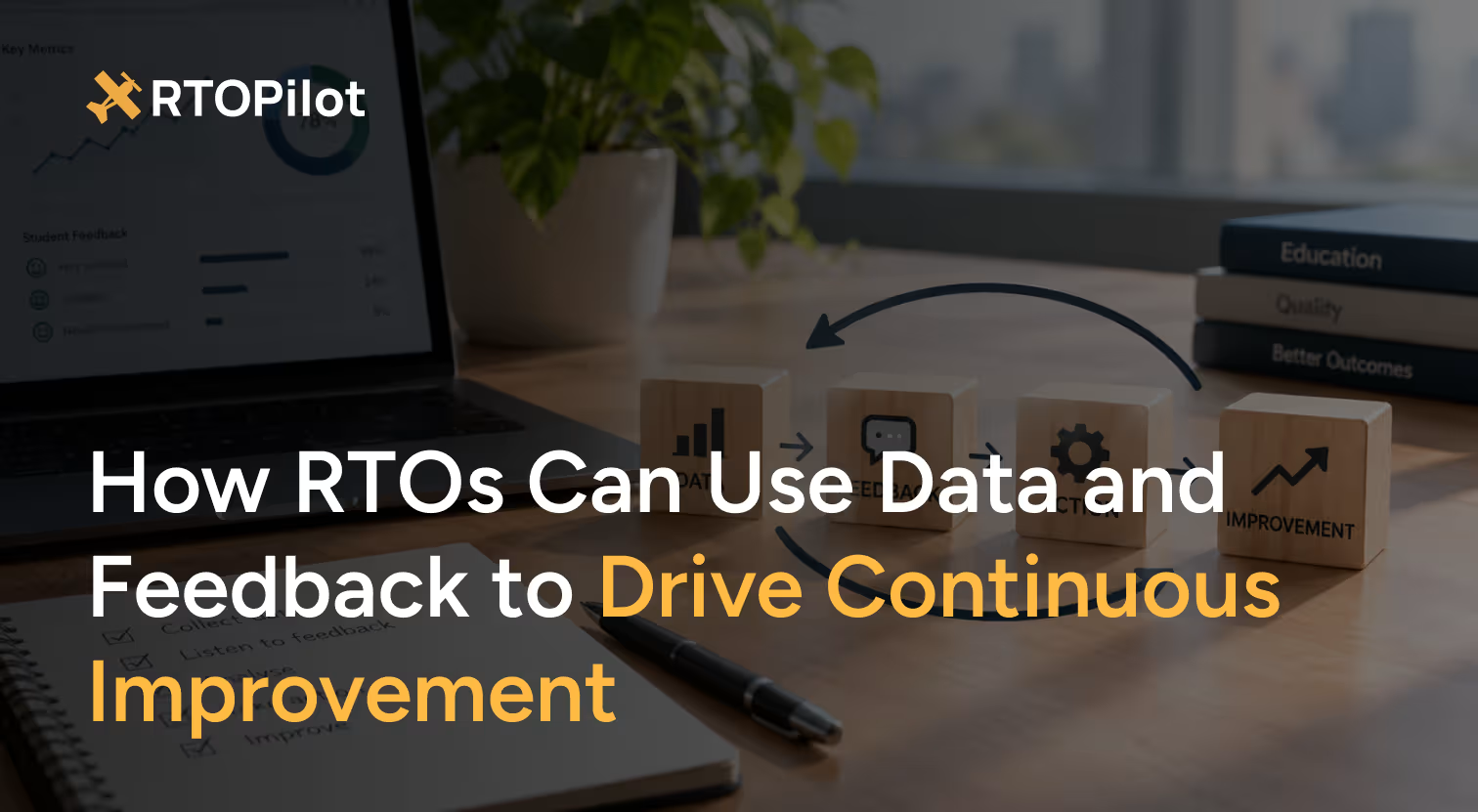
The Continuous Improvement Loop: Collect, Analyse, Act, Evidence, Review
Every RTO's continuous improvement cycle looks a little different, depending on team size, systems, and the mix of data sources in play. If you don't already have a defined cycle, use this five-step loop as your default. It covers everything Standard 4.4 expects and gives you a consistent structure to apply across every data source above.
- Collect: Gather data from every relevant source on a defined schedule, rather than only when a problem is reported.
- Analyse: Review the data for patterns rather than isolated incidents. A single complaint may be a one-off. Three similar complaints in a term point to a process issue.
- Act: Assign an owner and a timeframe for the action. Vague intentions to "look into it" don't hold up as evidence.
- Evidence: Record what was changed, when, and by whom. This is the step most RTOs skip, and the one auditors ask for first.
- Review: Check whether the action actually worked. If the issue persists, the loop starts again.
Example: applying the loop to a real complaint trend
An RTO's compliance officer logs three student complaints in one term, all about unclear assessment instructions for the same unit (Collect). Reviewing the register, she confirms it's not a one-off: all three complaints reference the same task and the same ambiguity (Analyse). She assigns the unit's training and assessment strategy owner to rewrite the instructions within two weeks, with a review date set in the calendar (Act). The owner rewrites the instructions, and the compliance officer records the change in the unit's version history, noting the date, the reason, and who approved it (Evidence). The following term, she checks complaint numbers for that unit and confirms they've dropped to zero, closing the loop with evidence that the action worked, not just that it happened (Review).
How to Measure Continuous Improvement
There's no single method ASQA requires for demonstrating continuous improvement. Some RTOs run a formal framework such as DMAIC (Define, Measure, Analyse, Improve, Control) or PDCA (Plan, Do, Check, Act); others build their own system around internal audits, testing how well existing processes protect quality for students and industry.
Any of these can work. What matters is that your RTO can show the monitoring is systematic and ongoing, not that it follows one particular named model. To measure continuous improvement properly, your RTO needs a clear position on:
Against Indicator 1 (system for monitoring):
- Is data being collected on the schedule set out in your policy?
- Are all required sources (students, staff, industry, employers) actually represented in the data?
Against Indicator 2 (outcomes informing improvement):
- What percentage of logged issues have an assigned action and a completion date?
- How long, on average, does it take to close an action once it's identified?
Against Indicator 3 (lawful data collection and analysis):
- Is feedback data stored and handled in line with privacy obligations?
- Can you produce a clear trail from data point to analysis to decision?
Use these questions to test whether your RTO can demonstrate this in practice:
- How do you monitor and evaluate your performance against the Outcome Standards and Compliance Requirements?
- How do you engage with ASQA proactively to identify and address non-compliance?
- How do you involve stakeholders, including staff and students, in identifying opportunities for improvement?
- What systems do you have in place to collect and analyse data and feedback from students, staff, industry, employers, and regulators?
- How are the outcomes of your monitoring and evaluation used to improve your performance and the quality of your services?
Closing the Loop
Manually tracking every feedback source and complaint for audit evidence is overwhelming. RTOPilot helps you consolidate and automate it all, keeping you audit-ready. Book a demo today.
Frequently Asked Questions
Continuous improvement is a shared responsibility, though most RTOs assign a compliance officer or quality manager to own the system, coordinate data collection, and report outcomes to the governing body. Trainers, assessors, and other staff contribute data and carry out changes within their own area.
No formal framework is mandated under Standard 4.4. ASQA assesses whether your monitoring is systematic and produces evidence of improvement, regardless of which named methodology, if any, your RTO chooses to use.
RTOs should retain continuous improvement records for at least the period ASQA requires for compliance evidence, typically covering the current registration cycle and the audit period before it. A longer history also makes it easier to tell whether an issue is a genuine pattern or a one-off.
Continuous improvement applies to RPL assessment the same way it applies to full training delivery. Feedback on RPL processes, outcomes, and turnaround times should feed into the same review cycle as other assessment data, since RPL carries equal weight to full training under the Standards.



Is your RTO future-ready?
See how RTOPilot can help.
Designed to help you spend less time and save money in running your RTO.
